The Wildlife Trusts’ 2025 marine review

The Wildlife Trusts’ 2025 marine review

A year of disasters, discoveries and determination around UK shores

The Wildlife Trusts’ annual Marine Review highlights the work of over 100 Living Seas marine ecologists around our shores, supported by thousands of volunteers.

2025 was the year in which the terms ‘nurdle’ and ‘bio-bead’ became headline news, with devastating implications for marine life. These low points were matched by an outpouring of emotion and display of people power following the release of Sir David Attenborough’s film ‘Ocean’, which opened the nation’s eyes to the devastating impacts of bottom trawling.

Despite a marine heatwave, life prevailed. New species were discovered, cherished puffins had a bumper year on the islands of Skomer and Muck, and Cornwall Wildlife Trust declared it The Year of the Blooming Octopus following an unprecedented increase in numbers.

Common Octopus seen on the Lizard peninsula, Cornwall in June 2022 by underwater photographer Shannon Moran

Common Octopus seen on the Lizard peninsula in June 2022, Image by Shannon Moran

Ruth Williams, Head of Marine at The Wildlife Trusts, says:

“The year was bookended by environmental disasters – the North Sea tanker collision in March and in November the release of tonnes of bio-beads off the Sussex coast. Our Wildlife Trust staff and volunteers are making huge efforts to protect and restore our shorelines.

“In 2025 we’ve recorded mussel beds forming off the Sussex coast in an area previously decimated by bottom trawling. Now the Government needs to ban this horrific practice from all Marine Protected Areas.

“Despite the year’s challenges, we’ve had moments of joy and wonder. Our conservationists have celebrated successes such as the first signs of puffin breeding on the Isle of Muck and transplanted seagrass growing healthily off the Essex coast. They’ve also been flabbergasted by the incredible numbers of octopuses recorded this year.”

Our marine review, below, covers:

1. How we stood up for our seas in an emotional year following the release of ‘Ocean’

2. The man-made disasters of 2025 and how our teams responded

3. The nature-based solutions being trialled to safeguard shores from rising seas

4. How invasive non-native species are spreading in warmer waters

5. Surprises, successes and joyful moments – octopuses, seals, puffins and more

6. Our predictions for 2026

1: Standing up for our seas – an emotional year that made a difference

Protection of UK seas made significant advances and came under scrutiny as never before – but threats continue.

  • Sir David Attenborough’s film ‘Ocean’ was a box office hit. It revealed the harsh reality of the industrialised fishing practice of bottom trawling the ocean floor.
  • A survey by The Wildlife Trusts revealed that most people thought the practice was already banned in Marine Protected Areas (MPAs).
  • The Government and Marine Management Organisation launched a long-awaited public consultation into whether the practice should be banned in 41 English offshore MPAs. 18,000 members of the public wrote to the Government expressing, often with great emotion, their support for a ban. We are still waiting for the outcome of the consultation.
  • In a parliamentary debate on the High Seas treaty (16 October) MPs expressed their horror at the practice, backing an outright ban and saying that ‘large factory ships now plunder the ocean as if it were a bottomless pit of profit.’
  • Scotland took a step forward in protecting MPAs. New fisheries management measures for some offshore MPAs came into force in October. These special areas were designated over a decade ago to conserve and recover vulnerable marine habitats and species in deep and continental shelf seas. They will now benefit from restrictions on bottom trawling, longlines and bottom set gillnets in certain areas.
  • Nearly five years since a landmark ban on inshore bottom trawling off the coast of Sussex, local divers reported more than 100 football pitches-worth of mussel beds growing on the seabed. Fishermen reported increases in sea bream.
  • Sussex Wildlife Trust took legal action to protect an MPA off Beachy Head. They won. The MMO reversed a decision to allow the dumping of dredged sediment into the seas above an area famed for its chalk reef, home to short-snouted seahorses.
Ruth Williams, The Wildlife Trusts' head of marine conservation stood in front of the Ocean film poster with Matt Walpole, Chief Executive of Cornwall Wildlife Trust

Ruth Williams, The Wildlife Trusts' head of marine conservation with Matt Walpole, Chief Executive of Cornwall Wildlife Trust

2: Man-made disasters put pressure on fragile marine wildlife and seashores

Up to eleven million metric tonnes of plastic enters our oceans annually and a third of fish caught for human consumption now contains plastic. In 2025, events conspired against our marine wildlife to worsen this problem still further. Local heroes stepped in.

  • The collision of an oil tanker and a container ship in the North Sea in March led to the release of giant quantities of plastic resin pellets. North Sea bordering Wildlife Trusts were on the front line of dealing with the consequences and managing much of the clear-up. 18.76 tonnes of burned nurdles were cleared from Lincolnshire beaches over 400 hours. The beach clean volunteers were joint winners of the 2025 Marsh Volunteer Award for Marine Conservation. The nurdles reached Norfolk with significant plastic pollution at Holmes Dunes and Cley Marshes. On Durham beaches, higher concentrations of nurdles than usual were found at Seaton Carew and Crimdon.
  • Nearly 4.5 tonnes of bio-beads were released by Southern Water in November from a water treatment centre in Sussex. These 5mm black plastic pellets, used in water treatment processes, can be carcinogenic due to the hydrocarbons and heavy metals which attach to their surfaces. They are easily digested by marine animals. Millions of beads polluted Camber Sands and Rye Harbour nature reserve where Sussex Wildlife Trust is still battling to remove them from precious saltmarshes – designated as a Site of Special Scientific Interest – and notable for 80 species of bird. It is a Herculean task.
  • The battle for clean beaches continues countrywide:
    • Essex Wildlife Trust’s pollution project ensured 82 litter-picking heroes collected 142kg of litter this year – more than double the amount collected in 2024.
    • The Wildlife Trusts of South and West Wales organised 127 beach cleans, spending 95 hours collecting 4,600 pieces of plastic from beaches around New Quay. 290 volunteers took part.
    • 180 volunteers joined Kent Wildlife Trust on litter picks. At Pegwell Bay they collected 200kg of litter.
    • Volunteers for Norfolk Wildlife Trust spent 350 hours on beach cleans.
  • Fishing industry’s negative impact on marine wildlife was notable in Devon. A 4m-long female thresher shark died after becoming tangled in netting. An extremely rare, 3.5m Pygmy sperm whale was found dead at Bigbury-on-Sea. The likely cause of death was head trauma. Bycatch in fishing gear is now thought to account for a third of the deaths of common dolphins found stranded on beaches around the south-west.
  • Manx Wildlife Trust produced a guidance document for boat owners and water sports enthusiasts on how to behave around marine wildlife.
Bycatch

3: Future-proofing shores and restoring habitats: ecology meets innovation

Wildlife Trust staff and volunteers around the UK are on the ground, trialling nature-based solutions to help build resilience against the reality of rising sea levels and storm damage. In July, the National Oceanography Centre reported that UK seas are rising faster than the global average.

  • 300,000 native oysters have now been returned to the Humber Estuary in Yorkshire to improve water quality and re-create the protective reef which once existed there. Ecologists continue to trial different restoration methods, including settling oyster larvae onto scallop shells before they are placed onto the sea floor.
  • Seagrass meadows are one of the unsung habitat heroes of coastlines, storing carbon, nurturing wildlife and, importantly, conserving the shoreline. Several Wildlife Trusts are engaged in restoration. Trials in Essex saw 150 cores transplanted from a donor meadow and showing good growth. Seagrass is now thriving in Northumberland's River Aln and Jarrow's River Don. And after a 100-year absence, there’s now seagrass in Hampshire’s River Hamble. 58,000 seagrass seeds were planted this spring and European eel have since been spotted here.
  • Highlighting kelp: A travelling show in the Northeast has explored how kelp can limit the impacts of coastal erosion. Sussex also hosted the first UK national kelp summit, Progress Beyond Protection.
  • At Fingringhoe Wick, Essex Wildlife Trust is celebrating the tenth anniversary of a 22ha saltmarsh established as intertidal habitat. Now it has an abundance of brent goose, black-tailed godwit, dunlin, avocet, plus bass, grey mullet and European eel.
A native oyster is shown against a rocky beach background

Matt Slater

4: Marine wildlife is all at sea – invasive non-native species and other visitors

The Met Office recorded a significant marine heatwave during the summer, with land heatwaves, increased sunshine and weaker winds allowing sea temperatures to rise. This led to the spread of invasive non-native species and some interesting visitors.

  • Many invasive non-native species are being recorded by Shoresearch volunteers, allowing marine experts to monitor their spread:
    • Slipper limpets recorded for the first time at Wembury, Devon. In Yorkshire, they reached Filey Brigg after previously being recorded at Spurn Point, 60 miles away.
    • Pacific oysters appeared on Alderney. These were introduced to the UK from Canada during the 1960s for commercial purposes. The first UK record in the wild was in 1965. They’re native to Japan and north-east Asia. In the Dutch Wadden Sea and more recently in Great Britain they have started to form reefs made of dense layers which can ultimately be detrimental to birds.
    • Pom Pom weed (Caulacanthus okamurae) is native to Japan, China, Taiwan and Korea. It has now reached the south and southwest of the UK.
    • Devil’s tongue weed (Grateloupia turuturu), also native to Japan and Korea has now reached southern England and Pembrokeshire in Wales.
    • Moss animals, or red ripple bryozoan, are marine invertebrates which live in large colonies and can impact their surrounding ecosystems.
  • The first UK record of a pink-orange ‘hair curler’ sea slug was made by Cornwall Wildlife Trust Shoresearch volunteer Charlotte Cumming at Prisk Cove on the Helford. Usually resident in the Caribbean, Mediterranean, and western Atlantic coasts, sightings of the nudibranch Spurilla neapolitana had, until now, only been made as far north as Brest, France. Hair curler sea slugs are covered in, long, thick growths.
  • Climate change indicator, sea slug Discodoris rosi was recorded by volunteers in Devon. Several sightings of the recently arrived and aptly named warty Doris sea slug were made off the Dorset coast.
  • The first volcano barnacles in North Wales were recorded this year. They’re moving north due to climate change. This species is usually found in the Mediterranean, southward to the coasts of Africa and northwards up the Spanish and French coasts to the south-west coasts of Great Britain.
  • Montagu’s crabs (Xantho hydrophilus), a strong climate change indicator, are now the most dominant crab species in South Devon and Cornwall. With their black-tipped claws, short legs and grooved carapace, they have a distinctive muscular appearance giving them their alternative local name of ‘body builder crabs’.
Sea slug with purple curls

Image by Charlotte Cumming

5: Surprises, successes and joyful moments

Diligent conservation work and record keeping by Living Seas teams pay dividends.

  • It was the Year of the Blooming Octopus, with exceptional numbers of octopus vulgaris (the common or Mediterranean octopus, rarely seen in UK waters), the first since 1950. ‘Incredible’ numbers were reported along the south coast from Penzance into South Devon, with Seasearch volunteers recording a 1500% increase on numbers from the ‘mini bloom’ in 2023. These blooms occur periodically but the mild winter and warm breeding season helped. Octopuses were filmed ‘walking’, cleaning themselves and mating. One was filmed grabbing at an underwater camera.
  • The first Capellinia fustifera sea slug in Yorkshire was recorded by Shoresearch volunteer Caroline Pindar, a ‘tiny but mighty’ achievement. These 12mm long molluscs, resembling gnarly root vegetables, are usually found in the south-west.
  • In other sea slug news: Aeolidiella alderi, Elysia viridis and Placida dentritica (two species of ‘solar-powered’ sea slugs) were recorded by volunteers in Devon.
  • Variable Blenny, a mediterranean fish, was discovered off the coast of Sussex for the first time. Previously, populations have been limited to the west country.
  • Hurricane Melissa blows a loggerhead turtle off course. This resident of the Gulf of Mexico surprised tourists on a boat off St Ives, Cornwall.
  • A shy angelshark was spotted in Cardigan Bay, Wales. Critically endangered, it is one of the world’s rarest shark species and was caught on underwater cameras – the first such sighting in four years. Experts think angelsharks give birth in Welsh waters.
  • A sunfish heads to Norfolk. This unusual species is like a giant swimming head. It is relatively common in the waters off the southwest coast but this year made an appearance off Norfolk.
  • In Essex protective cages helped ensure ringed plovers nesting on the sand were not predated by foxes and crows. 49 chicks hatched successfully, a record year.
  • A record number of grey seals were recorded at South Walney nature reserve near Barrow by Cumbria Wildlife Trust. A total of 563 seals were counted. Previous highest counts were 518 in 2021, 483 in 2019 and 360 in 2018, showing an upward trend.
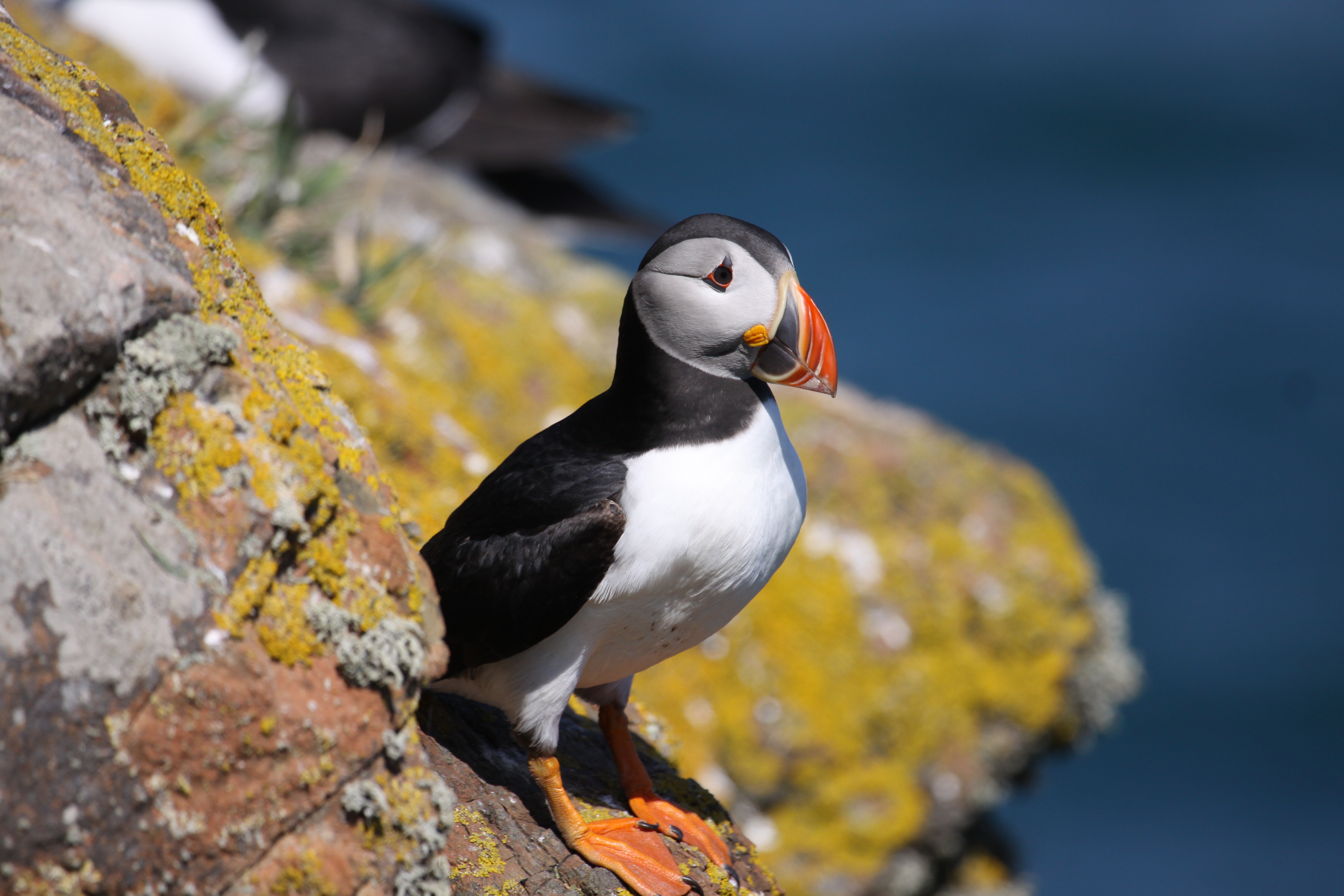
  • Record numbers of puffin – more than 46,000, smashing the record of 42,500 in 2023 – were recorded on Skomer by the Wildlife Trusts of South and West Wales.
  • Puffins made a comeback on the Isle of Muck. Thanks to conservation efforts by Ulster Wildlife Trust, puffins were caught on camera exiting a nesting burrow.
  • Wembury Bay in Devon was designated an Important Shark and Ray Area, thanks to its shallow, sheltered waters and the presence of a red-listed shark species, the nursehound, the largest of the UK’s cat sharks.
  • A grey seal makes a 320-mile journey from her home in off the northwest coast of Germany to East Yorkshire. Yorkshire Wildlife Trust were able to establish her point of origin after spotting an orange tag on her flipper.
  • A spectacular bluefin tuna 'boiling sea' event was recorded by the Alderney Wildlife Trust. Hundreds of tuna ferociously circled a shoal of prey fish, creating a large bait ball for them to feed from in the largest spectacle of its kind recorded here.

Octopus periscoping in Porthkerris, Cornwall - Paul Naylor


6: The Wildlife Trusts’ marine forecast for 2026

  • More octopus, less cod and haddock: The World Meteorological Organisation predicts that global temperatures are expected to continue at or near record levels in the next five years – leading to the heating of the ocean and rising sea levels. Winter temperatures are remaining very high year on year. The implications are wide-reaching.
    • Our fish species are changing with cod and haddock now only found in northern UK and smaller fish like anchovy and sardine becoming prevalent in the southwest. Garfish are becoming common in the southwest too, these are prey for blue fin tuna so we will see more of these top predators.
    • Octopus eggs are surviving our warming winters so we are likely to see a regular occurrence of octopus blooms in future years. Our fisheries need to adapt, as octopuses eat lobsters, crabs and shellfish.
    • Non-native invasive species like Pacific oysters and climate change indicator species, currently at the northern limit of their historic range, also prefer warm seas so are likely to continue to spread. This spread will impact our native habitats and species.
  • More managed retreat: Our teams will be exploring more nature-based solutions to tackle and adapt to climate change, rising sea levels and changing habitats. Managed retreat and saltmarshes are a natural flood alleviation habitat as well as providing carbon storage.
  • We will continue our campaign to end bottom trawling: The consultation and campaign in the summer of 2025 was just the first step and the MMO are now analysing all responses to that consultation. We continue to lobby Government and Defra energetically and we have the support of thousands of members of the public and many MPs. Meanwhile the Scottish Government is expected to consult on fisheries management measures for inshore MPAs and Priority Marine Features in Scotland. The Scottish Wildlife Trust will be encouraging communities to respond.
Super trawler